Imagine receiving a genuine employment offer from an Austrian company, building a career in one of Europe’s most stable economies and gaining international experience in a country known for advanced industries, high living standards and strong worker protections. For qualified professionals, this goal can be realistic—but only when the applicant chooses the correct immigration route and supports it with accurate evidence.
The term Austria Work Visa is widely used, but Austria’s system is not based on one universal employment visa. Most qualified third-country nationals use a residence and work authorisation such as the Red-White-Red Card or EU Blue Card. Very highly qualified applicants may first use a six-month Job Seeker Visa. Seasonal employees, researchers, intra-corporate transferees and other workers can have different procedures.
At Primex Visa Pvt. Ltd., we help eligible applicants turn a complex process into a clear plan. Our team can assess the profile, explain potential categories, prepare a tailored document checklist and review applicant information for consistency. Austrian diplomatic missions, residence authorities and the Public Employment Service—known as AMS—make all official decisions. We cannot guarantee a job, visa, residence card or permanent residence.
This page is structured as a practical career roadmap rather than a conventional immigration article. It helps candidates move from the first question—“Which route fits me?”—to job verification, points, documents, application, arrival and long-term planning. All figures and policies should be checked on Austria’s official Migration Portal before filing.
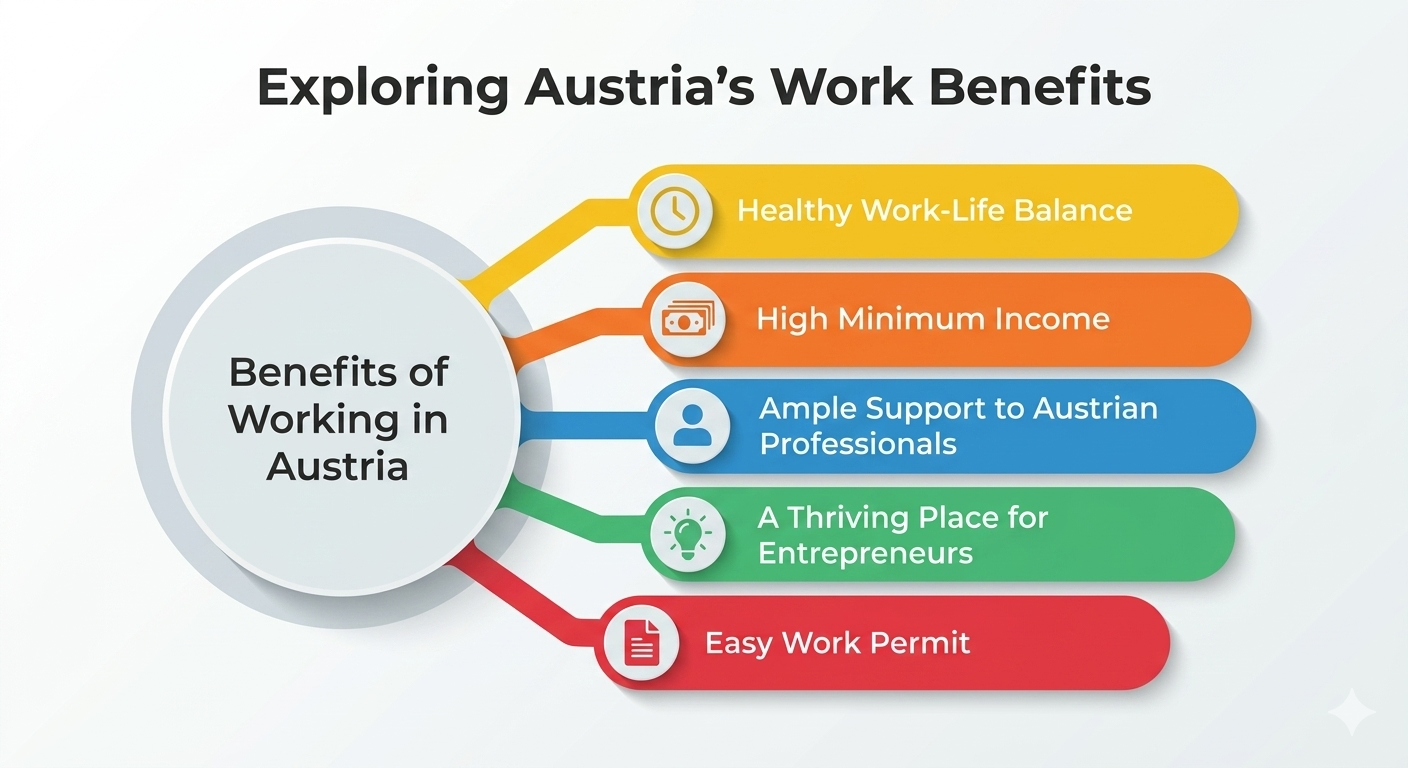
Austria sits at the centre of Europe and has a diversified economy supported by manufacturing, engineering, technology, tourism, healthcare, life sciences, construction, energy, transport and professional services. Vienna is an international business and diplomatic centre, while Upper Austria, Styria, Salzburg, Tyrol, Vorarlberg, Carinthia and other regions have distinctive industrial and labour needs.
Professionals may value:
Regulated employment and collective-agreement standards
Strong engineering, manufacturing and technical sectors
Healthcare and skilled-trade demand in selected occupations
Tourism and hospitality employment in qualifying circumstances
Public transport, infrastructure and social insurance
Opportunities for spouses and children under family-reunification rules
A pathway from an employer-specific Red-White-Red Card to broader labour-market access
Possible long-term residence after sustained lawful settlement and integration
Access to multilingual and international workplaces
Germany is widely used in daily life and most workplaces. English may be sufficient for selected international roles, but German ability improves employability, workplace integration and points under several immigration categories.
EU, EEA and Swiss citizens generally have free-movement rights and do not use the ordinary third-country worker routes. Indian citizens and most other non-European nationals are third-country nationals and normally need appropriate permission for long-term work.
For a stay longer than six months, a residence permit is generally required. For shorter stays, an applicant may need a visa and, depending on the activity, an employment permit. A Schengen visitor visa does not ordinarily authorise employment.
The applicant’s nationality, job, duration, qualifications and current location determine the procedure. Travelling as a tourist based on a promise that an employer will “convert” the status later can create serious legal problems. A valid application from inside Austria is possible only in situations permitted by law and does not necessarily grant a right to remain beyond lawful stay in every category
Most long-term professional applicants compare these options:
Red-White-Red Card for very highly qualified workers
Red-White-Red Card for skilled workers in shortage occupations
Red-White-Red Card for other key workers
Red-White-Red Card for Austrian graduates
Red-White-Red Card for regular workers in tourism, agriculture and forestry
EU Blue Card
Job Seeker Visa for very highly qualified workers
Red-White-Red Card for self-employed key workers or start-up founders
Temporary routes for ICT employees, researchers and special assignments
The right Austria Work Visa route is the one that matches the facts. A candidate should not inflate a salary, change a job title or claim experience merely to reach a threshold
The Red-White-Red Card combines fixed-term residence and employment rights. It is normally granted for 24 months and is tied to the employer specified in the application. It is available to several categories of qualified third-country nationals.
For many Indian applicants, this employer-specific residence title is what they mean when searching for an Austria Work Visa. Understanding its category rules before accepting an offer can prevent wasted fees and avoidable delays.
The system uses points for selected categories. Points can be awarded for education, vocational training, work experience, age, language ability, research, salary history and Austrian studies, depending on the route. Passing the points threshold does not itself guarantee approval. The applicant must also have the required job offer where applicable, compliant salary, health insurance and a positive assessment by AMS.
The official Red-White-Red Card overview should be used to identify the correct category and current checklist.
*Need assistance applying for Austria work visa? Sign-up with Primex Visa for end-to-end support.
This route is intended for candidates with exceptional academic, scientific, managerial or professional profiles. It is the only major Red-White-Red pathway that can allow an eligible person to enter Austria for job searching before securing an offer.
Applicants need at least 70 points out of 100. Points can come from:
A four-year higher-education programme
A degree in mathematics, informatics, natural sciences or technology
A doctorate or post-doctoral qualification
Senior-management salary history with a qualifying company
Research, publications, patents or recognised awards
Relevant work experience
German or English at A1 or A2
French, Spanish, Bosnian, Croatian or Serbian at B1
Age below 35, 40 or 45
Previous higher education completed in Austria
A candidate with 70 points but no Austrian job offer may apply for a six-month Job Seeker Visa. After finding employment matching the qualifications and offering adequate pay, the candidate applies for the Red-White-Red Card.
The Job Seeker Visa is a Category D visa available only to very highly qualified persons meeting the 70-point threshold. It permits entry for up to six months to search for suitable employment. It is not a general job-search visa for every applicant and does not provide unrestricted work rights.
Applicants apply personally at the Austrian embassy or consulate responsible for their home country or lawful country of residence. AMS verifies the points. Documents include passport, recent photograph, accommodation, health insurance, sufficient funds and evidence supporting every claimed point.
If the person finds a suitable job while the visa is valid, they can apply for the corresponding Red-White-Red Card. If no qualifying job is secured, the person must leave before the visa expires. The official page currently lists the Job Seeker Visa fee as €195, but applicants should reconfirm it before applying.
Austria publishes national and regional shortage-occupation lists. A third-country national can apply under this category when:
The occupation appears on the current applicable shortage list
The applicant has completed training in that occupation
There is a binding Austrian job offer
The salary meets the law, regulation or collective agreement
The applicant scores at least **55 points out of 90**
The official shortage-worker guidance allocates up to 30 points for qualification, 20 for relevant experience, 25 for language ability and 15 for age. Five additional points can apply for English where it is the predominant company language.
Shortage lists change annually and can differ by federal state. A profession appearing in an old article is not proof of 2026 eligibility. The occupation title, training and actual duties must align with the current regulation.
Consider a candidate aged 29 with completed training matching a current shortage trade, five years of relevant experience and A2 German. Qualification can contribute 30 points, five years of experience can contribute up to 10, A2 German can provide 10, and age under 30 can provide 15. The total would be 65 points, above the 55-point minimum.
This example is illustrative. AMS independently calculates points based on acceptable evidence. The candidate still needs a binding job offer and legally compliant pay.
The Other Key Workers category can suit qualified applicants whose occupation is not on a shortage list. The worker must score at least 55 points, receive the required salary and pass a labour-market test.
For 2026, the official Other Key Workers page states a minimum gross monthly salary of €3,465. The employer must also pay any higher amount required by law, regulation or collective agreement.
AMS checks whether an equally qualified registered jobseeker can be placed in the position. Points are available for vocational training, university-entry eligibility, a tertiary degree, relevant experience, German or English, other recognised languages and age. Certain professional athletes and coaches can receive bonus points.
This route is not a substitute for the shortage-worker category. The labour-market test and salary threshold make it a distinct assessment.
The EU Blue Card is designed for highly qualified employment and does not use a points system. An applicant normally needs:
A university or tertiary programme lasting at least three years
A binding Austrian job offer related to the education
The prescribed minimum salary
A labour-market test showing no equally qualified registered jobseeker is available
Health insurance and general residence compliance
Professional authorisation for regulated work
For 2026, the official Austria EU Blue Card page lists at least €55,678 gross annually, including annual salary and special payments.
ICT professionals and service managers can qualify without a degree in limited circumstances by proving at least three years of relevant professional experience comparable to a three-year tertiary programme, acquired during the seven years before application.
The Austrian EU Blue Card is generally valid for 24 months and linked to the named employer. After qualifying employment for at least 21 months during the preceding 24 months, the holder may apply for a Red-White-Red Card Plus.
Choosing the right Austria Work Visa depends on the profile:
A shortage-trade worker with appropriate vocational training may prefer the shortage-occupation route.
A university graduate with a related high-paying offer may qualify for an EU Blue Card.
A candidate outside the shortage list may consider Other Key Workers.
An exceptional academic or research profile without an offer may consider the Job Seeker Visa.
A recent Austrian graduate may have a dedicated graduate route.
The EU Blue Card has no points test but requires education-job alignment and the annual salary threshold. Red-White-Red categories can accept broader profiles but apply category-specific points and conditions.
Third-country students who complete eligible studies at an Austrian university or university of applied sciences may extend their student residence for a job-search or business-start period under current conditions. After obtaining an offer matching their qualification and paying the required graduate-level remuneration, they may apply for a Red-White-Red Card.
This route is different from entering Austria from India as a new worker. Graduation, current lawful status, job relevance and timely filing are important.
Austria provides a Red-White-Red category for certain experienced regular workers in tourism, agriculture and forestry. Eligibility depends on a history of registered seasonal employment, German ability, a permanent job offer and other current conditions.
It should not be confused with ordinary seasonal work. A first-time hospitality applicant does not automatically qualify merely because Austria recruits in tourism. The worker must meet the precise history and evidence requirements.
Tourism is important in Vienna, Salzburg, Tyrol, Vorarlberg, Carinthia and other regions. Hotels and restaurants can recruit chefs, cooks, housekeeping staff, restaurant professionals, front-office employees and managers when labour and immigration rules are satisfied.
Potential profiles include:
Chef, sous chef and chef de partie
Commis chef and specialist cook
Restaurant manager and supervisor
Waiter or waitress
Bartender and bar manager
Front-office manager and receptionist
Housekeeping supervisor and room attendant
Food and beverage manager
Hotel operations specialist
A vacancy does not automatically create a long-term work route. The employer, occupation, salary, collective agreement, qualifications, experience, German ability and available immigration category determine eligibility.
Points should be calculated using documents, not assumptions. A candidate claiming education points should confirm programme duration and institution status. Experience letters should state employment dates, hours, role and duties. Language certificates must come from accepted providers and normally should not be older than five years.
The official Austria points calculator is useful for preliminary checking, but the result is not a legal decision. AMS awards points after examining the submitted evidence.
Age points are based on the applicant’s age at the relevant assessment stage. A birthday near filing can change the total. Candidates close to the minimum should avoid relying on uncertain evidence
The Red-White-Red points system recognises German and English at different levels depending on category. For shortage and other key workers, German can provide five points at A1, ten at A2 and fifteen at B1. English can provide five at A2 and ten at B1. An additional five points may apply when English is the predominant company language.
Accepted German certificates can include ÖSD, Goethe-Institut, telc and the Austrian Integration Fund. Accepted English evidence can include Cambridge, telc, IELTS, TOEIC or TOEFL. Always confirm the current list and validity.
Language points are not the same as workplace readiness. Hospitality, healthcare and customer-facing roles may demand stronger German than immigration’s minimum scoring level
A genuine offer supporting an Austria Work Visa should identify:
Employer’s complete legal name and address
Job title and detailed duties
Workplace and federal state
Gross monthly or annual salary
Special payments such as 13th and 14th salary where applicable
Weekly working hours
Collective agreement and classification
Employment start and contract duration
Probation, leave and notice
Employer’s authorised signature
Austria frequently uses collective agreements that set minimum pay by sector, role and experience. The immigration threshold does not permit an employer to underpay the applicable collective-agreement amount.
Verify the company independently. Do not purchase an offer or pay an individual for a “guaranteed AMS approval.” A genuine employer must submit an employer’s declaration with detailed information about the position.
Formal recognition is required mainly for regulated professions. These include healthcare professions, public-school teaching, preschool teaching, law and other legally controlled occupations. The official Professional Recognition portal identifies the competent body.
For many non-regulated occupations, full formal equivalence is not required. AMS assesses qualification documents as part of the Red-White-Red Card application. However, the applicant must still prove the training and programme duration claimed for points.
Recognition, immigration and employer selection are separate decisions. Approval in one process does not guarantee the others.
Doctors, nurses, physiotherapists, medical technicians and other healthcare workers need professional recognition before practising independently. The process can involve curriculum comparison, German language evidence, professional examinations, supervised practice or additional training.
Healthcare candidates should investigate recognition before accepting an unrealistic start date. An Austria Work Visa does not replace registration or permission to use a protected professional title
Common documents include:
Valid passport
Recent photograph, usually 45 x 35 mm
Birth certificate where requested
Marriage or civil-status documents where applicable
Health-insurance evidence covering all risks
Current police clearance from the country of origin
Police clearance from another country of residence where applicable
Binding employment contract or offer
Employer’s declaration
Educational certificates and transcripts
Proof of institution status and programme duration
Vocational training or apprenticeship evidence
Detailed employment testimonials and experience certificates
Language certificates
Research publications, patents or awards for relevant claims
Salary evidence for very highly qualified managerial points
Professional recognition or licence for regulated work
Evidence supporting family applications
Authorities may ask for original documents, copies, German or English translations and legalised versions. Police certificates are often recommended to be no more than three months old
Documents not available in German or English generally require translation into one of those languages. The authority may require a sworn or certified translator. Indian public documents can need apostille or additional legalisation depending on the document and procedure.
Names and dates should remain consistent. If an applicant uses initials in one document and a full name in another, the difference should be explained lawfully. Never edit official records to create artificial consistency
The applicant can generally file the Austria Work Visa residence application personally with the competent Austrian embassy or consulate in the home country or lawful country of residence. Alternatively, the prospective employer can submit the Red-White-Red Card or EU Blue Card application with the competent residence authority in Austria.
The authority forwards employment and points elements to AMS. AMS checks the points, training, salary and labour-market conditions applicable to the route. The residence authority assesses general residence requirements.
If approved and the applicant requires a visa, the Austrian mission instructs the person to apply for a Category D visa to enter and collect the residence title
Residence authorities consider health insurance, public order and other legal conditions. Some residence titles require adequate subsistence and locally customary accommodation.
The official portal lists the general 2026 monthly reference rates as:
Single person: **€1,308.39**
Married couple: **€2,064.12**
Each child: an additional **€201.88**
Special rules apply to Red-White-Red Card and EU Blue Card cases. The employment-category salary requirements and exemptions should be read together with the general residence guidance rather than applied mechanically.
The official pages currently list an application fee of €218 for the Red-White-Red Card and EU Blue Card and €195 for the Job Seeker Visa. Fees can change and additional charges may apply for documents, visa D, translations, legalisation or services.
Processing time varies by category, authority, AMS assessment, document verification and professional recognition. Missing documents can suspend or delay the process. Applicants should avoid non-refundable travel until approval and should not resign based only on a verbal promise
Visa-required applicants normally receive instructions to obtain a Category D visa after residence approval. The visa allows entry to collect the residence title. Follow the mission’s deadline and carry the required originals.
After arrival, register the residential address within the legally required period. Complete insurance and employer onboarding. Do not work outside the conditions printed on the card
The initial Red-White-Red Card and EU Blue Card generally authorise employment with the employer named in the application. Changing company requires a new application or authorised change.
For a Red-White-Red Card change, current official guidance allows provisional commencement after a 45-day waiting period from submission of a complete change application. For an EU Blue Card, the period is 30 days; after at least 12 months of Blue Card employment in Austria, immediate commencement can be possible. These are technical rules and should be confirmed before work begins
After working under the qualifying conditions for at least 21 months during the preceding 24 months, a Red-White-Red Card or EU Blue Card holder may apply for a Red-White-Red Card Plus.
The Plus card provides unlimited labour-market access rather than restricting employment to one named employer. The residence authority and AMS verify the employment history and other conditions. A timely, accurate renewal file should include employment and insurance records
Eligible family members can apply for residence. Family can include a spouse, registered partner and qualifying minor children. Family members of Red-White-Red Card and EU Blue Card holders may obtain a Red-White-Red Card Plus, which can provide broad labour-market access.
The family application can require:
Legalised marriage and birth records
Passport and photographs
Evidence of the sponsor’s residence title
Health insurance
Adequate income and accommodation where applicable
Proof of German language ability where legally required
Custody and consent evidence for children
The exact requirements depend on the sponsor’s permit, family member, nationality and filing time. No relative should begin work until their own residence and labour rights are confirmed
After five years of continuous lawful settlement, some third-country nationals may qualify for EU long-term residence if they meet general requirements such as secure income, accommodation, health insurance, integration and lawful history. Absences and temporary residence categories can affect continuity.
Citizenship is a separate, more demanding process and is not automatically granted through employment or permanent residence. Applicants should avoid advertisements promising an Austrian passport after a fixed number of working years.
Primex Visa Pvt. Ltd. can assist eligible applicants pursuing an Austria Work Visa through:
Profile and route assessment
Preliminary points calculation
Comparison of Red-White-Red Card and EU Blue Card categories
Personalised applicant checklist
Review of education, experience and language evidence
Employer-offer and salary consistency review
Guidance on professional recognition
Translation, apostille and legalisation planning
Form and supporting-letter review
Employer and applicant information coordination
Embassy appointment preparation
Assistance with further-document requests
Family-reunification checklist guidance
Pre-departure and arrival planning
We provide transparent process support. We do not sell jobs, create fake contracts, control AMS or promise approval.
Austria rewards well-matched qualifications, genuine employment and careful preparation. The most successful candidates do not begin with a promise of approval; they begin by selecting the correct route, documenting every point and verifying the employer.
Contact Primex Visa Pvt. Ltd. for a personalised assessment. We can help you approach your Austria Work Visa journey with confidence, transparency and a practical plan.

You can reach us at our office at
Regd. Address: B-49, 50 & 51, Somdutt Chamber-2, Bhikaji Cama Place, New Delhi – 110066
Office Timings: Monday to Saturday (10 A.M. to 5 P.M.)
Contact number: +91-9911225019, 9911225091
You can also write to us at info@primexvisa.com